flowchart LR
  Intent["Accepted intent receipt"]
  Contract["Versioned contract"]
  Edge["Conformance map"]
  Gate["Observed-state authority gate"]
  Plan["Plan and typed job"]
  Effect["Attempt and observed effect"]
  Artifact["Artifact, verifier, delivery"]
  Evidence["Feedback, compensation, residuals"]
  Recontract["Block, narrow, or re-contract"]
  Intent --> Contract
  Contract --> Edge
  Edge --> Gate
  Gate -- "blocked" --> Recontract["Block, narrow, or re-contract"]
  Gate -- "accepted" --> Plan
  Plan --> Effect
  Effect --> Artifact
  Artifact --> Evidence
  Recontract --> Evidence
30 Command Contracts: From Intent to Executable Work
30.1 Chapter status
| Field | Value |
|---|---|
| Chapter ID | intent-to-execution-contracts |
| Part | Part II - Planning, Memory, Reasoning, and Execution |
| Status | conceptual |
| Manuscript maturity | v0.3 layered instruction identity |
| Last updated | 2026-07-31 |
| Primary source records | viea, talos, software_magic_grimoire, genesiscode, moecot, cognitive_compilation, ext_camel_prompt_injection_2025, cca_project, moecot_manifest_project, beastbrain_project, bugbrain_project, corbens_best_model_possible_project, reflexive_router_whitepaper |
| Claim label | Design rationale |
| Evidence level | argument |
| Source queue | primary: viea, software_magic_grimoire; supporting: talos, genesiscode, cognitive_compilation, cca_project, moecot_manifest_project, beastbrain_project, bugbrain_project, corbens_best_model_possible_project, reflexive_router_whitepaper; comparator: ext_camel_prompt_injection_2025; connector/recovery: moecot |
| Source loading state | source notes: viea, deterministic_capability_compilation, talos, software_magic_grimoire, genesiscode, moecot, cognitive_compilation, ext_camel_prompt_injection_2025, cca_project, moecot_manifest_project, beastbrain_project, bugbrain_project, corbens_best_model_possible_project, reflexive_router_whitepaper; raw cache: viea, talos, software_magic_grimoire, genesiscode, cognitive_compilation; connector/recovery: moecot |
| Test state | Existing protocol, plan-execution, handoff, replacement-bridge, one-shot-action, and negative natural-work campaigns remain in force. The vertical refinement now requires 37 exact Lean declarations, kind-exclusive event payloads, arbitrary-run vertical invariants, one delivery witness, and eighteen closed countermodels; its independent consumer checks an executed nine-scenario governed repository-change result with 89 events and 30/30 rejected mutations. No general semantic equivalence, natural-language parser, authentic receipt, deployed approval service, complete effect, production transfer, or reliable useful-execution result is established. |
The executed merge combines two current record families:
- intent-to-execution traces, which ask whether accepted intent, constraints, approvals, artifacts, handoffs, dispatch receipts, evidence updates, feedback, stop/fault states, and residuals remain linked from request to delivery;
- command contracts, which ask whether objective, context, constraints, procedure, output contract, verification, failure behavior, field provenance, field confidence, bounded defaults, authority basis, re-contract points, and dispatch blockers are explicit before planning or execution can proceed.
30.2 Drafting guardrail
A command contract is not the same thing as a working parser or a secure dispatcher. It is the record a governed stack needs before parser quality, planner handoff, runtime enforcement, approval behavior, and artifact traceability can be tested honestly.
The argument does not ask readers to believe that a model can extract intent perfectly. It asks a narrower systems question: once intent has been accepted for work, what semantic fields, authority limits, receipts, artifacts, verification paths, failure behavior, and residuals must survive before tools or runtimes act?
30.3 Human Reading Path
Concrete lens. The output-only baseline accepts a correct summary. The vertical contract rejects the unauthorized method before judging output quality.
A person can ask for a complicated thing in ordinary language, with examples, hopes, limits, and uncertainty. A system should not treat that ordinary language as unlimited permission.
The first operational move is translation. The request becomes a contract that separates what the person wants from what the system is allowed to do, what it must produce, how success will be checked, what failure means, and when it has to stop or ask again. The contract is not a bureaucratic form. It is the boundary that prevents a helpful response from turning into an unauthorized action.
The path starts where the Human Intent layer hands off. The raw request has been captured, ambiguity has been bounded or escalated, and authority has been scoped. Now the stack needs a command object that planners, verifiers, job runners, runtime adapters, evidence ledgers, and later AI agents can all read without guessing.
The contract turns uncertainty into visible fields so downstream layers can refuse safely. That visibility keeps tools from acting on guesses or hidden permission.
30.4 Problem
After an intent owner accepts a request, every lowering into commands, plans, jobs, tool calls, effects, artifacts, verification, delivery, and residuals can change meaning or authority. A governed stack therefore needs a consumer-relative conformance contract that can detect semantic loss, unauthorized amplification, response-for-effect substitution, and incomplete delivery across the complete lineage rather than merely recording that each stage exists.
This is the distinct conformance interface. Human Intent owns interpretation and acceptance. Planning owns decomposition. Cognitive Compilation owns lowering. Runtime layers own capability enforcement and effects. Artifact Graphs own durable lineage. Intent-to-Execution Contracts owns the relation those layers must preserve between the accepted receipt and the terminal outcome. It asks whether the same objective, non-goals, constraints, affected parties, authority, state assumptions, allowed means, output and effect postconditions, verifier, stop rules, failure behavior, and residual duties survived each transformation.
30.5 Why existing approaches are insufficient
Prompt templates, typed schemas, planning languages, workflow engines, capability systems, approval dialogs, event logs, provenance graphs, and formal route theorems each constrain part of the path. None alone proves that the accepted obligation survived every representation and material effect.
Field presence is not semantic agreement. A digest is not meaning. A dispatch receipt is not an observed effect. A fluent response is not delivery. A self-reported verifier is not independent acceptance. A zero-release route is not useful or safe execution. The current evidence illustrates each boundary: the synthetic fixtures trust hand-authored fields; the Lean theorems prove finite consequences from declared predicates; the first governed-work route released nothing; the 36-transaction campaign found only two correct model candidates; the first natural final-contract campaign emitted no parseable outputs; and the repaired renewal produced only two correct candidates, no useful release in either arm, and a frozen denominator error.
ReAct, PDDL, SHOP2, Temporal, Airflow, BPMN, TLA+, Dafny, and CaMeL remain comparators for action traces, explicit planning, durable workflows, specification, verification conditions, control/data separation, and capability enforcement. They are not local reproduction evidence and do not establish the proposed end-to-end conformance relation.
30.6 Core Claim
[intent-to-execution-contracts.core, label: Design rationale, support: argument] Intent-to-Execution Contracts should own a versioned, consumer-relative conformance relation between an accepted intent receipt and the complete execution lineage. Before any material dispatch, the relation binds exact objective and non-goals, semantic fields and precedence, authority ceiling and affected parties, state and environmental assumptions, allowed and forbidden means, artifacts and effect postconditions, verification and independence requirements, budgets and stop conditions, failure and compensation behavior, expiry and re-contract triggers, and the required receipts through plan, job, adapter, observed effect, artifact, delivery, feedback, and residual custody. Each lowering or effect must either preserve that relation under independently checkable evidence or stop, narrow, clarify, re-contract, compensate, or leave an explicit residual.
The contract cannot infer human intent, grant authority, choose a plan, make a tool safe, prove semantic equivalence, establish verifier correctness, or count non-release as useful execution by itself. All chapter-core support therefore remains at argument.
Reader claim. Execution remains faithful only while every lowering preserves the accepted objective, non-goals, authority, means, stop conditions, evidence, and residuals; a helpful change of means can still violate intent.
Operational rule. Carry stable contract and authority identities through plan, job, approval, dispatch, effect, observation, artifact, verification, delivery, and feedback. Any changed means, widened authority, lost non-goal, self-verification, or inexact rollback stops the lineage and requires clarification, re-contract, or quarantine.
30.6.1 Worked vertical trace: the output is right, the means are forbidden
An accepted contract asks for a public project summary and forbids uploading private source files. Planning lowers the task into a typed job; the job chooses an external summarization service that would receive the entire repository. The service might produce the correct summary, but the dispatch payload violates the forbidden-means field before any effect occurs. The vertical contract rejects the lowering and returns to planning for a local or source-minimized route.
If an adapter nevertheless sends data, later output quality cannot repair the authority and means breach. The lineage records the attempted effect, observed state if available, compensation limits, and quarantine residual. The local refinement follows nine scenarios containing 89 events and six material effects, with 30 source mutations. It checks exact payload and custody ordering across a ten-event delivery witness, but it trusts the authored semantics, authority, receipts, observations, and rollback fields; it does not prove parser correctness, semantic equivalence, tool safety, or effect truth.
30.7 Draft Key Figure: Intent to Artifact Trace
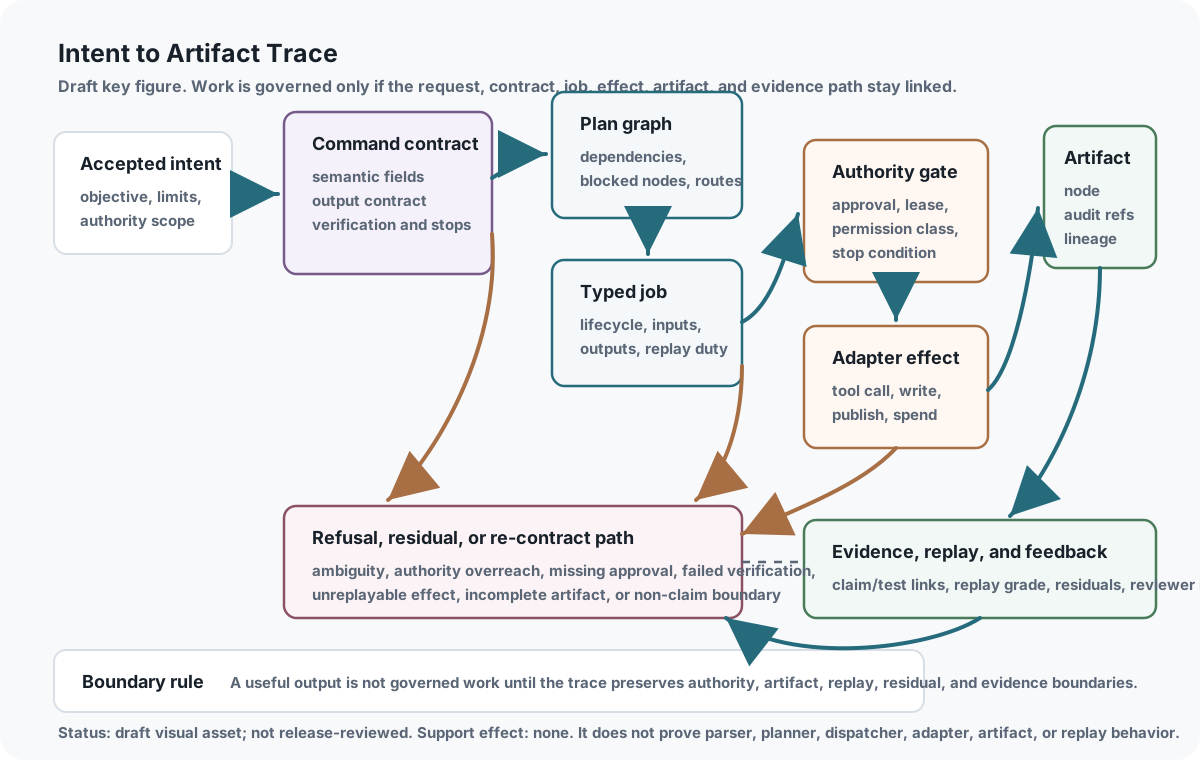
How to read the intent-to-artifact figure: Follow the allowed path from accepted intent through the command contract, plan graph, typed job, authority gate, adapter effect, artifact node, and evidence ledger. The lower path is equally important: ambiguity, authority overreach, missing approval, failed verification, unreplayable effects, incomplete artifacts, or non-claim boundaries route to refusal, residual custody, or re-contracting instead of quiet execution. The figure is a draft reader aid, not proof of parser correctness, planning quality, dispatcher enforcement, adapter safety, artifact completeness, replay behavior, support-state movement, or release approval.
30.7.1 Intent resolution before command lowering
The conformance relation begins with an accepted intent receipt; it does not own the interpretation that produced one. This chapter owns typed lowering and lineage conformance from accepted objective and non-goals through authority, plan, job, approval, dispatch, observed effect, artifact, verification, delivery, feedback, and residual custody. Human Intent as a Formal Input is the stable technical-detail owner for preserving the raw request, separating desired outcome from allowed and forbidden means, extracting only supplied authority, recording affected parties and boundaries, classifying assumptions and ambiguities, and managing clarification, revocation, appeal, expiry, and re-contract.
The placement blocks assumption laundering in both directions. A well-formed intent contract does not prove that the interpretation is complete, consent is informed, authority is authentic, or downstream execution conforms. A conformant execution lineage does not prove that the accepted interpretation captured the person’s real preference or every affected party’s authority. The parent does not inherit intent-understanding or consent claims; the technical route does not inherit lowering, tool, effect, artifact, rollback, or delivery claims. Both retain separate sources, claims, proof targets, tests, failures, evidence exits, support ceilings, IDs, and URLs. Composition creates no permission, semantic equivalence, useful outcome, support, deployment, or release result.
30.8 Mechanism
The mechanism begins only with an accepted intent receipt. It creates a versioned command contract whose fields carry stable identities, units, quantifiers, precedence, provenance, confidence, materiality, defaults, unknowns, consumers, verifiers, and downstream consequences. Context, retrieved material, examples, tool output, and model reasoning remain data; an authorized control boundary must adopt them before they can change a command.
The contract defines a conformance edge for each lowering: accepted intent to command, command to plan, plan to typed job, job to adapter request, request to independently observed effect, effect to artifact, artifact to verification and delivery, and delivery to feedback, compensation, and residual custody. Each source obligation records its downstream representation, transformation rule, permitted loss, consumer, verifier, and failure consequence. A material change creates a new contract version or a re-contract request.
Conformance is evaluated per consumer and per obligation, not as one document status. A lowering can preserve an objective while dropping a forbidden means, preserve authority while changing the target state, or produce the requested file without causing the accepted external effect. Each edge therefore needs a typed comparison result, the exact source and target representations, the observer that made the comparison, uncertainty and disagreement, and the downstream consequence of failure. Missing information blocks or narrows only the affected obligation when that can be done without changing meaning.
The lifecycle is also bidirectional. Runtime observations, artifact evaluation, delivery failure, user correction, delayed harm, or incomplete compensation can invalidate an earlier conformance judgment. The contract then expires the affected descendants, preserves prior receipts, and routes a repair, re-contract, recovery, or residual instead of rewriting history into a success.
How to read the flow: The contract is not a permission token. The conformance map and observed-state gate decide whether the proposed lowering still refers to the accepted work. Requested, planned, dispatched, acknowledged, attempted, observed, compensated, verified, delivered, and useful remain distinct states. Any missing or conflicting obligation routes to an explicit non-success outcome rather than conversational momentum.
30.8.1 One-shot privileged action binding
A general command contract is still too broad for a privileged effect. The effect approval must be a one-shot capability that binds the exact principal, operation, target identity, pre-effect target-state digest, parameter digest, policy version, issuance time, expiry, nonce, and authority reference. At dispatch, the observed principal, operation, target, state, parameters, policy, and nonce must match byte-for-byte. After an effect receipt and post-state are recorded, the nonce becomes consumed and every replay attempt is denied.
The five historical projects supply one local lineage of positive and negative design pressure. CCA and MoECOT Manifest motivate typed request/effect records, policy identity, and replayable receipts. BeastBrain and BugBrain expose the danger of acknowledgement, simulated success, or a nominal state transition standing in for an authorized material effect. Corben’s Best Model Possible adds the runtime-causality boundary: a named tool, transition, or digest is not enough unless the exact authorized parameters reach the observed effect. These are source-note and roadmap inputs, not five replications or evidence that any historical implementation enforced the protocol.
stateDiagram-v2
  [*] --> Requested
  Requested --> Resolved: exact target and parameters
  Resolved --> Approved: principal + policy + TTL + nonce
  Approved --> Dispatched: all bindings still match
  Dispatched --> EffectObserved: effect receipt + post-state
  EffectObserved --> Consumed: nonce burned
  Approved --> Expired: TTL elapsed
  Approved --> Revoked: authority revoked
  Requested --> Denied: acknowledgement substituted
  Consumed --> Denied: replay attempted
Reading the one-shot lifecycle: approval is neither a reusable role nor a scenario checkbox. It is a short-lived capability for one exact state transition. Any identity, state, parameter, policy, time, or nonce mismatch routes to denial before effect; successful observation consumes the nonce.
30.8.2 Strongest objection
The strongest objection is that exact digests and a nonce can make an unsafe action perfectly replay-resistant. That is correct. Binding proves neither that the policy is wise nor that the approver understood the consequence. It prevents an approval for one principal, state, parameter set, and policy from being silently reused for another. Policy quality, interface comprehension, OS enforcement, and effect safety remain separate owners and residuals.
30.8.3 Command contract validation states
Command contracts move through explicit validation states:
| State | Meaning | Allowed movement |
|---|---|---|
draft |
Fields are being extracted or normalized. | No planning dispatch. |
field_complete |
Required fields exist but may include inferred/defaulted values. | Validation and review only. |
conflict_detected |
Context, examples, hidden instructions, or fields conflict with explicit constraints. | Residual or clarification. |
authority_inferred |
A means, tool, disclosure, publication, or effect is inferred rather than granted. | Draft-only or re-contract. |
dispatch_blocked |
Required output, verification, failure, approval, or authority field is missing or vague. | No plan node dispatch. |
validated_for_planning |
Required fields are concrete and precedence review passed. | May lower into a plan graph. |
superseded |
A newer command contract replaces the current one. | Historical trace only. |
These states are intentionally pre-execution states. They do not say the work is correct. They only say whether the contract is clear enough to become planning input.
30.8.4 Canonical events and command precedence
The Reflexive Router adds a pre-deliberative ingress contract before ordinary command lowering. A canonical event envelope keeps event_id, authenticated principal, issuance and receipt time, modality, tenant, privacy class, authority handles, context handles, resource budget, literal payload, and requested route constraints outside open-ended interpretation. The envelope does not prove the payload is truthful or the request is permissible; it gives those questions stable identities and prevents parser convenience from rewriting their scope.
Four ingress modes should remain distinguishable throughout the trace:
- unmarked natural-language input requesting automatic routing;
- a forced route that names a semantic capability but permits no silent fallback;
- a direct command whose typed arguments are bound without action interpretation; and
- a compiled workflow whose nodes and dependencies are already explicit.
All four converge on the same authority, qualification, consequence, verification, effect, and audit boundaries. The user-dispatch invariant is therefore precise: an override may bypass inference, but never enforcement. Untrusted text that merely resembles command syntax remains literal data unless the authenticated command plane adopts it. A registry binding may expand only into typed fields; it may not interpolate trusted shell, SQL, URL, or prompt fragments.
The contract also owns fallback fidelity. deny, defer, clarify, quarantine, rollback, no_route, and contract_rejected are distinct terminal or remediation outcomes with reasons and residuals. If the requested route is stale, unknown, unauthorized, or underqualified, the system reports that fact and the exact fallback authority rather than presenting another route as though it honored the command. These are proposed contract semantics from a Corben-authored paper, not evidence that a parser or dispatcher implements them; support remains argument.
30.8.5 Instruction identity has layers
An instruction needs more than a memorable name. Software Magic Grimoire usefully separates a human title, a short working seal, and an exact canonical form. The governed version extends that into an Instruction Identity Record:
- human title and purpose;
- immutable instruction and contract version;
- canonicalization schema and normalizer version;
- ordered typed fields, relations, word-sense namespaces, and literal values;
- a standard cryptographic digest of that canonical record;
- redaction-safe identity for sensitive literals;
- model, runtime, policy, context, tool, environment, verifier, and consumer dependencies required to interpret or replay a run;
- supersession, compatibility, revocation, and migration history.
These layers answer different questions. A title makes the instruction browsable. A working handle makes it portable. A canonical record detects specified structural change. None proves semantic equivalence, correctness, authorization, confidentiality, or successful replay. Gödel-style prime-exponent numbering is one injective encoding of a chosen finite token stream, not a solution to ambiguity; a versioned canonical record and ordinary cryptographic digest are the practical identity surface.
Identity also includes choreography. Reordering workflow stages, changing a transition guard, widening a default, removing a failure route, altering a loop budget, or changing a recursive base case creates a new version even when the human title stays the same. Concrete paths, versions, target names, and values remain typed literals rather than disappearing because they are absent from a shared vocabulary. This makes instruction drift inspectable without pretending that hashes understand meaning.
30.8.6 The command registry is a governed instruction set
An explicit command is not a trusted text macro. It is a versioned binding between an authenticated name and a semantic route, capability, resource profile, or workflow. Its descriptor declares owner and scope; aliases and namespace; positional, named, optional, and defaulted parameters; permitted context variables; authority and effect class; confirmation policy; budgets; verifier; fallback; renderer; compatible capability versions; provenance; review date; and revocation state. Routine invocation uses a conventional lexer, parser, registry lookup, and typed argument binder. Natural language may help author a descriptor once, but it does not reinterpret the binding on each use.
Defaults are dependencies, not conveniences hidden from the trace. A command that reads $profile.default_location, $context.active_document, $context.last_result, or $time.today declares the dependency, scope, freshness rule, and missing-value outcome. A supplied argument overrides a default for that invocation without mutating the command. The resulting dispatch receipt records both the requested route or effort profile and the one actually realized; an unavailable high-effort profile cannot be silently downgraded unless the contract explicitly authorizes that fallback.
Resolution is deterministic across reserved, fully qualified, session, personal, workspace, shared, and platform namespaces. The interface must let a principal inspect the active binding and shadowed alternatives, preview exact effects, dry-run it, compare capability and authority diffs, disable it, view history, and roll back a prior version. A model may propose a shortcut after repeated use, but registration and any later expansion of authority, consequence, target set, or hidden dependency require a separately authorized mutation. Imported command packages remain executable supply-chain artifacts: names such as /morning or /weather do not disclose their permissions.
Command-looking strings in documents, webpages, messages, quoted examples, tool output, and model output remain inert data. Literal escaping and a small non-overridable recovery namespace keep it possible to discuss a command, inspect permissions, stop execution, or recover a damaged registry without activating the named operation. These rules turn the user-visible vocabulary into an inspectable personal instruction set without letting convenience syntax acquire ambient authority.
30.8.7 The capability charter as executable intent
Deterministic Capability Compilation gives the command contract a downstream compilation target: the capability charter. The charter binds input and output schemas, preconditions, postconditions, invariants, failures, authority, cost, observability, recovery, uncertainty, non-goals, and accepted residuals before an executable scaffold or learned replacement exists. It is narrower than human intent but richer than a task description.
The scaffold is executable evidence about the charter, not the charter’s full meaning. Every lowering from accepted intent to charter, scaffold, semantic capability graph, corpus, expert, NCO, linked route, and effect must retain a semantic obligation ledger. A behavior present in the scaffold may still be a specification defect; a human obligation absent from the scaffold remains uncompiled rather than silently satisfied. This creates a precise re-contract route when the student, environment, or tribunal exposes a missing or mistaken requirement.
30.9 Interfaces
Human Intent owns interpretation, ambiguity, consent and authority extraction, affected-party coverage, bounded defaults, and acceptance. Constitutional, moral-uncertainty, and system-authority owners supply prohibitions, rights, delegated capabilities, and unresolved conflicts. The conformance layer consumes those records and may narrow them; it cannot repair or widen them silently.
Planning owns decomposition and ordering. Cognitive Compilation owns semantic lowering. Labor OS owns typed job lifecycle. Runtime Adapters and the Security Kernel own capability enforcement and observed effects. Artifact Graphs own durable identity. Verification, Evidence States, and Readiness Gates own evaluation, support movement, and release. Resource Economics owns cumulative cost. Rights, privacy, licensing, and publication owners retain their own approval surfaces.
The contract’s job is to make each handoff testable. Every consumer returns a conformance, blocked, attempt, effect, artifact, decision, delivery, compensation, or residual receipt. A graph can therefore be complete while semantically wrong; a runtime can enforce an authority token while executing the wrong accepted task; and a verifier can accept a file that was never delivered to the intended consumer. Those are separate failures, not one green workflow state.
Each field carries confidence/provenance metadata:
| Field status | Meaning | Dispatch rule |
|---|---|---|
confirmed |
Explicitly stated or accepted by the user/governance boundary. | May support planning. |
policy_imposed |
Added by active policy, constitution, or safety rule. | May constrain planning; cannot broaden authority. |
source_derived |
Taken from an authorized source artifact. | May support context or requirements within source limits. |
defaulted |
Filled by a bounded default. | Must carry scope and re-contract trigger. |
inferred |
Guessed from context or pattern. | Cannot authorize side effects. |
missing |
Required value absent. | Blocks dispatch or narrows output to clarification/draft. |
This metadata keeps field confidence from becoming hidden evidence. A field can be useful and still too weak to authorize work.
30.10 Invariants
These invariants are end-to-end obligations, not assurances supplied by a schema. Each one requires exercised producers and consumers at every relevant edge, rejecting mutations for ordinary and adversarial failures, and an observed consequence when it fails. A field that is present but never changes a decision remains documentation rather than control.
- Every material field has an authoritative source, precedence, provenance, confidence, consumer, verifier, and consequence; typed presence alone is insufficient.
- Objective, non-goals, constraints, parties, authority, forbidden means, state assumptions, budgets, stops, criteria, failure behavior, and residual duties remain traceable through every lowering.
- Context and untrusted content remain data unless an authorized control boundary adopts them; they cannot widen authority.
- Inferred, defaulted, stale, conflicting, or missing authority cannot authorize a material effect.
- Every material transformation either satisfies a declared conformance relation or produces a loss, ambiguity, repair, narrowing, or re-contract record before dispatch.
- Planning, compilation, routing, retries, fallbacks, and repair remain inside the accepted envelope.
- A privileged effect matches principal, operation, target, pre-state, parameters, policy, capability, environment, expiry, nonce, and authority at observed dispatch time.
- Requested, planned, dispatched, acknowledged, attempted, observed, compensated, rolled back, verified, delivered, and useful remain distinct.
- Artifact identity includes contract version, producer lineage, receipts, criteria, evaluator, delivery, feedback, and residuals.
- Verifier dependencies, exposure, criterion version, error, and disagreement remain visible; self-report cannot silently become independent acceptance.
- Every attempt, failure, timeout, abstention, retry, discard, side effect, cost, compensation, and residual remains in the denominator.
- Resource, privacy, rights, authority, and opportunity costs follow the whole lineage and cannot reset at handoffs.
- Material changes expire the relevant contract and require revalidation or re-contract.
- Stop, denial, rollback, compensation, quarantine, and re-contract routes require observed effects and accountable residual owners.
- A complete receipt proves only its exact lineage, not correct interpretation, wise policy, safe tools, useful execution, or production transfer.
- Zero dispatch or release is abstention, not evidence of usefulness or safety advantage without an estimable matched denominator.
- No component may approve its own broader authority, support state, or public release.
30.11 Failure modes
The failure surface includes intent laundering, field laundering, semantic drift, context injection, authority inference, approval drift, acknowledgement substitution, replay laundering, response substitution, effect-gap laundering, artifact identity loss, verifier capture, success scalarization, denominator erasure, fail-closed theater, ceremonial recovery, contract ossification, and governance-cost externalization.
The three most deceptive cases are ordinary. A model can produce plausible prose while never satisfying the requested final contract. A governed route can release nothing and look safe while producing no useful denominator. A complete lineage graph can preserve every identifier while the meaning changed during compilation. The conformance contract therefore requires semantic, authority, effect, artifact, usefulness, safety, cost, and recovery outcomes to remain separate.
30.12 Minimum Viable Implementation
The current minimum now includes both the record-and-route scaffold and one executed vertical refinement. Intent, command, and trace schemas; synthetic plan-execution, handoff, replacement-bridge, and one-shot action fixtures; and one consumed hand-authored five-project lifecycle remain. The reachable Lean model adds explicit command, plan, job, authorization, dispatch, attempted and observed effect, artifact, verification, delivery, rollback, residual, and quarantine states. Its 37 exact declarations make event payloads kind-exclusive and prove the vertical invariant across arbitrary accepted runs: root-contract and authority-ceiling custody, bounded active authority, monotone logical time, approval and dispatch custody, attempted and observed effect accounting, artifact and independent-verification custody, exact delivery accounting, stopped blocking, positive residualization, and failed- rollback quarantine. One ten-event trace reaches delivery, while eighteen closed countermodels reject custody substitution, stale time, smuggled payloads, premature transitions, self-verification, inexact rollback, and quarantine without residual custody. The independent consumer also checks the complete nine-scenario governed repository-change result, 89 events, six effects, six observations, two exact rollbacks, and thirty rejecting source mutations.
This is still a fixed local repository task with trusted event and receipt fields. It tests concrete transition and result-schema conformance, not whether a natural-language request retained its meaning through arbitrary lowering.
The empirical attempts are equally important to the minimum because they stop the schema from masquerading as capability:
- 16 model runs produced zero governed releases and two inexact rollbacks;
- 36 transactions produced only 2/36 correct candidates and four inexact attack-control rollbacks;
- 12 natural-work tasks produced zero parseable final contracts; and
- the repaired renewal completed 32 candidates but produced only 2/32 correct candidates, zero useful releases in either arm, zero unsafe releases in either arm, and a frozen 8/8-versus-9/9 metadata discrepancy.
The later P4/M5 recampaign finally reached an informative regime without rewriting those failures. After a 40-candidate tuning pool populated all four useful/safe cells, a fresh 16-task held-out campaign admitted 15 candidates. Two evaluator implementations agreed on every admitted row. The candidate’s self-release baseline released none; the frozen full-governance contract released 9 useful and 0 unsafe candidates, while removing evidence freshness released one additional useful-unsafe candidate. This is accepted only as the bounded non-core claim governed-usefulness.held-out-local-policy-effect at synthetic-test-backed. It does not show that arbitrary natural-language intent is lowered correctly, that self-release is the strongest baseline, or that the effect transfers beyond one authored corpus and one quantized model.
An honest next minimum is a prospectively frozen natural multi-model contract campaign with human-authored, direct, schema-only, and governed comparators; independent semantic and effect observers; identical authority and candidate conditions; exact lineage and cost; nonzero useful-release opportunity; delayed outcomes; causal ablations; effect-complete recovery; replication; and transfer. The current scaffold meets a narrow local policy-selection subclaim, not that broader bar.
30.13 Mature Research Target
The mature target is evaluated as a semantic and causal system, not a larger prompt template. Prospectively sampled natural tasks compare human-authored contracts, direct execution, schema-only extraction, strong workflow and capability baselines, and the full governed route using identical models, tools, data, authority ceilings, candidate bytes, budgets, and outcome horizons.
Independent implementations score interpretation fidelity, obligation preservation, authority precision and recall, untrusted-data separation, plan/job conformance, observed effects, artifact satisfaction, useful delivery, unsafe release, abstention, missed help, delayed harm, rights and privacy effects, rollback and compensation completeness, latency, compute, human labor, and total governance cost. Causal ablations test every claimed mechanism. Adversaries attack ambiguity, injection, authority, replay, evaluator capture, state drift, residual erasure, and cost hiding. Replications span models, languages, modalities, task families, runtimes, organizations, jurisdictions, threats, and time.
Promotion requires a nonzero useful denominator, effect-bearing controls, strong matched baselines, independent evaluation, reproducible raw artifacts, and accepted claim-specific transitions. Otherwise the result is narrowed, null, negative, refuted, or blocked after full attempt. This remains a research target, not evidence of reliable intent extraction, safe useful execution, production transfer, AGI, or ASI.
No current result meets this intent-preservation endpoint; support remains argument until useful effect-bearing natural workloads, independent evaluation, causal controls, reproduction, and transfer pass.
30.14 Codex test plan
| Test | Purpose | Status |
|---|---|---|
| Contract field completeness test | Check that intent_contract, command_contract, and intent_execution_trace fixtures carry required objective, authority, output, verification, failure, handoff, artifact, feedback, residual, and non-claim fields. |
implemented by protocol validation; validated locally |
| Constraint preservation test | Check that every accepted vertical edge preserves one root contract and exact artifact parent and cannot widen authority or apply hidden overrides. | implemented in AsiStackProofs.IntentExecutionRefinement; finite transition semantics only |
| Approval-gated execution test | Check that authorization and dispatch require approval/receipt custody and that effect and delivery require prior dispatch, observation, artifact binding, and independent verification. | implemented in AsiStackProofs.IntentExecutionRefinement; deployed approval-service behavior is not established |
| Command schema validation test | Check that command contracts expose objective, constraints, output contract, verification, and failure behavior before planning input is accepted, and that a missing required field blocks completeness. | implemented in AsiStackProofs.CommandSemanticRefinement, retained finite negative cases, and protocol fixtures |
| Failure-behavior declaration test | Check that missing failure behavior blocks dispatch rather than becoming an implicit best-effort command. | implemented by finite predicates and synthetic fixture checks |
| Execution dispatch route proof | Check that a finite dispatch review routes missing contracts, missing objective fields, authority widening, hidden overrides, missing approvals, missing artifacts, missing verification plans, known residuals, and complete dispatch reviews to explicit outcomes. | implemented by Lean build; finite-record route coverage only |
| Prompt override scenario | Check that hidden, retrieved, or conflicting instructions cannot override explicit contract constraints. | implemented as a reachable precedence transition, retained finite negative case, fixture classification, and mutations; not run against a deployed parser or model |
| Intent-origin preservation fixture | Check that explicit intent constraints, forbidden means, stop conditions, re-contract triggers, and authority ceiling survive into command and plan records. | implemented by synthetic plan-execution contract harness; no parser, dispatcher, or runtime claim |
| Ambiguity dispatch block fixture | Check that unresolved ambiguity cannot validate a command for planning or dispatch a plan. | implemented by synthetic plan-execution contract harness; no natural-language ambiguity parser claim |
| Hidden override rejection fixture | Check that hidden override requests must be rejected, quarantined, or ignored before planning. | implemented by synthetic plan-execution contract harness; no deployed prompt-injection containment claim |
| Intent-authority ceiling fixture | Check that a command contract cannot widen the explicit intent authority ceiling. | implemented by synthetic plan-execution contract harness; no deployed authority-extraction or approval-service claim |
| Field-confidence audit | Check that confirmed, policy-imposed, source-derived, defaulted, inferred, and missing fields preserve dispatch consequences. | implemented by the plan-execution fixtures plus reachable AsiStackProofs.CommandSemanticRefinement transitions; no parser-quality or deployed-dispatch claim |
| Authority-inference block test | Check that inferred means, tools, disclosure, publication, or side effects route to draft-only or re-contract states. | implemented by synthetic plan-execution contract harness; no deployed authority-extraction, approval-service, or runtime side-effect claim |
| Intent-to-execution handoff probe | Check that a synthetic vertical trace preserves accepted intent, command contract, plan, typed job, dispatch receipt, adapter receipt, artifact link, verification reference, feedback, residuals, and a missing-approval blocked path while rejecting approval bypass, authority widening, hidden override application, missing dispatch receipt, side effect without adapter receipt, residual erasure, and missing artifact-to-parent links. | implemented by python3 scripts/validate_intent_execution_handoff_probe.py with two valid synthetic handoff traces and seven expected-invalid controls; no parser, deployed dispatcher, approval-service, runtime-adapter, artifact-satisfaction, support-state-promotion, or evidence-transition claim |
| Intent-governed replacement bridge | Check that command-contract authority can feed a replacement transaction only when intent refs, command refs, authority ceiling, stop conditions, forbidden means, evidence requirements, canary scope, monitor window, rollback owner, residuals, and non-claims survive; also check that default replacement without approval is blocked. | implemented by python3 scripts/validate_intent_governed_replacement_bridge.py with two valid synthetic bridge traces and six expected-invalid controls; does not parse natural-language intent, execute a deployed dispatcher, prove approval-service behavior, execute replacement, execute rollback, promote support state, or create an evidence transition |
| One-shot privileged-action lifecycle | Bind approval to principal, exact target state, parameter digest, policy version, TTL, nonce, observed effect, post-state, and single-use replay denial; reject scenario acknowledgement as approval. | implemented by python3 scripts/validate_one_shot_privileged_action.py with one consumed five-project record and ten expected-invalid mutations; no approval service, privileged effect, OS enforcement, or support promotion |
| Executed vertical Intent-to-Execution refinement | Refine the reachable contract-to-delivery model against the complete executed governed repository-change result across release, pre-effect refusal, exact rollback, failed-rollback quarantine, residual custody, and concrete source mutations. | implemented by python3 scripts/validate_intent_execution_vertical_refinement.py: nine scenarios, 89 events, six effects and observations, two exact rollbacks, two residual scenarios, and 30/30 rejected mutations; support-state effect none |
| Executed command semantic-interface refinement | Bind and preserve exact objective, constraint, output, verification, failure, and authority slots with provenance/confidence, authority, blocker, approval, validation, and dispatch custody, while keeping interface validity separate from downstream validity. | implemented by python3 scripts/validate_command_semantic_refinement.py: 13 schema-valid command fixtures classified as five interface violations, two correct blocks, and six interface-admissible records; five reachable events; 38/38 rejected mutations; support-state effect none |
The current repository state supports synthetic contract tests plus one source-anchored executed vertical refinement. That refinement is materially stronger than field-shape proofs, but it remains one deterministic local task and does not establish general semantic conformance or deployment.
The executed vertical consumer runs with python3 scripts/validate_intent_execution_vertical_refinement.py and records experiments/intent_execution_vertical_refinement/results/2026-07-15-local.json. It validates the complete source result against its public schema, then checks exact event order, accepted changed paths, artifact receipts, independent effect observation and evaluator identity, refusal causality, rollback, quarantine, and residual custody. Thirty mutations alter concrete source fields and are all rejected. Its support-state effect is exactly none.
The Intent-to-execution handoff probe is the current vertical fixture. It runs with python3 scripts/validate_intent_execution_handoff_probe.py and records experiments/intent_execution_handoff/results/2026-07-02-local.json. It has two valid synthetic handoff traces: one accepted command path from intent receipt through command, plan, typed job, dispatch receipt, synthetic adapter receipt, artifact reference, verifier reference, feedback, and residuals, and one missing-approval path that stops with a block receipt before dispatch. Its seven expected-invalid controls reject dispatch without approval, authority widening, hidden override application, missing dispatch receipt, side effect without adapter receipt, residual erasure, and missing artifact-to-parent links. The probe creates no support-state transition and no evidence transition.
The command semantic-interface refinement runs with python3 scripts/validate_command_semantic_refinement.py and records experiments/command_semantic_refinement/results/2026-07-15-local.json. Its independently encoded five-event model preserves six exact semantic slots, applies stricter confidence eligibility to authority, and requires precedence, approval, planning-validation, blocker, and dispatch custody. It validates all 13 command fixtures, identifies five command-boundary violations and two correct blocks, and rejects 38 mutations. Six records are command-interface admissible, but five of those still fail at downstream approval, lineage, DAG, receipt, or requirement-preservation gates; interface admissibility is not whole-fixture acceptance. Hashes and labels remain trusted finite inputs, and the result creates no support transition.
The Intent-governed replacement bridge is the current downstream authority consumer check. It runs with python3 scripts/validate_intent_governed_replacement_bridge.py and records experiments/intent_governed_replacement_bridge/results/2026-07-02-local.json. It checks two synthetic bridge traces: one command-authorized replacement request that can enter canary-only review, and one default-replacement request that is blocked because the required approval receipt is absent. Its six expected-invalid controls reject a missing intent reference, replacement authority widening, stop-condition erasure, default promotion without approval, missing rollback owner, and support-promotion overclaim. The bridge does not parse natural-language intent, execute a deployed dispatcher, prove approval-service behavior, execute replacement or rollback, move a support state, or create an evidence transition.
30.15 Formalization hooks
The destination chapter keeps three formal lanes:
AsiStackProofs.IntentExecutionRefinementfor the reachable vertical model, kind-exclusive payloads, exact contract/artifact joins, arbitrary-run authority, custody, time, effect-accounting, delivery, stop, residual, and quarantine invariants, one reachable delivery witness, and eighteen closed countermodels. It now ownslean:intent_execution.contracts.operational_invariantandlean:intent_execution.contracts.failure_blocks_promotion;AsiStackProofs.IntentToExecutionretains the general finite dispatch-route envelope, and its independent handoff consumer is bound to the nine retained branch theorems rather than a valid-summary projection:lean:intent_execution.contracts.dispatch_route_envelopeandlean:intent_execution.handoff_trace.probe_fixture_bridge;AsiStackProofs.CommandSemanticRefinementowns the reachable exact-slot, provenance/confidence, precedence, authority, planning-validation, blocker, approval, and dispatch-receipt model for all three stable command targets.AsiStackProofs.CommandContractsretains only bounded missing-field, accepted-override, and field-confidence branch lemmas:lean:command.semantic_interface.operational_invariantandlean:command.semantic_interface.failure_blocks_promotion, pluslean:command.semantic_interface.field_confidence_route.
The merged chapter does not take over AsiStackProofs.IntentContracts, because raw intent intake remains a separate Part I chapter.
The exact handoff target is: An independent finite handoff consumer validates accepted and missing-approval traces plus rejecting controls, while the retained Lean dispatch route family covers contract, objective, authority, override, approval, artifact, verification, residual, and ready branches.
Formal limitation and non-claim boundary: the three former assumption-restating Intent-to-Execution theorems—including the handoff valid-summary projection—and two projection-only Command theorems have been physically retired with frozen lineage. The reachable model proves exact finite transition and arbitrary-run invariant consequences, and its Python consumer checks one executed result schema. The retained priority-route and command-field theorems remain finite Boolean or enumerated branches. Together they do not prove field meaning, arbitrary compilation refinement, parser completeness, authentic authority, prompt-injection resistance, approval-service correctness, complete effects, verifier correctness, natural-workload utility, production behavior, reproduction, transfer, or chapter-core support.
The semantic audit classifies IntentExecutionRefinement as an adequate finite-record invariant only for its kind-exclusive payload discipline, one-step and arbitrary-run custody, authority, logical-time, effect-accounting, delivery, stop, and residual properties, one ten-event witness, and eighteen encoded rejection routes. Its 89-event independent replay and 30 mutations do not establish intent fidelity, authentic authority or receipts, effect truth or completeness, verifier competence, rollback efficacy, useful delivery, or deployment.
External positioning: the destination treats ext_react_2022 as an adjacent reasoning/action-trace baseline, ext_pddl_1998 and ext_shop2_2003 as planning-language and HTN-decomposition baselines, ext_temporal_docs, ext_airflow_dag_docs, and ext_bpmn_2_0_2_spec as workflow/process comparators, ext_tla_plus_home_docs as high-level system-modeling context, and ext_dafny_2010 as a specification-and-verification-condition baseline. The comparison is about interfaces and evidence boundaries, not a claim that the ASI Stack has implemented ReAct behavior, PDDL/SHOP2 translation, Temporal workflow replay, Airflow DAG execution, BPMN conformance, TLA+ model checking, Dafny-style verification, parser completeness, dispatcher correctness, or functional correctness.
30.16 Source crosswalk
reflexive_router_whitepaper supplies the passage-reviewed canonical-event, authenticated command-precedence, four-ingress-mode, literal-data, explicit fallback, and “bypass inference, never enforcement” design. It is a Corben-authored architecture proposal, not an implemented parser, dispatcher, authority service, or measured command result.
The Corben/local source crosswalk is organized by lane:
- intent-to-execution lineage:
viea,talos,software_magic_grimoire,genesiscode, andmoecot; - semantic-interface lineage:
software_magic_grimoire,viea,genesiscode,cognitive_compilation, andtalos. - one-shot privileged-action lineage:
cca_project,moecot_manifest_project,beastbrain_project,bugbrain_project, andcorbens_best_model_possible_project, treated as one related local lineage for exact approval/effect binding and negative cases rather than independent confirmation.
The external-source crosswalk stays comparator-only:
ext_react_2022for reasoning/action interleaving and action traces;ext_pddl_1998andext_shop2_2003for planning-language, domain/problem, action-schema, task-decomposition, and method-selection boundaries;ext_temporal_docs,ext_airflow_dag_docs, andext_bpmn_2_0_2_specfor durable workflow execution, event histories, DAG scheduling, process notation, and workflow metadata;ext_tla_plus_home_docsfor high-level system-modeling and state-transition discipline;ext_dafny_2010for specification and verification-condition discipline.ext_camel_prompt_injection_2025for trusted-query control-flow extraction, untrusted-data separation, and capability enforcement at tool calls, without claiming local intent extraction or universal prompt-injection resistance.
The adjacent human-intent chapter keeps its own comparator family: ext_goal_oriented_requirements_engineering_2001, ext_cooperative_inverse_rl_2016, and ext_deep_rl_human_preferences_2017.
No listed external source is local reproduction evidence.
30.16.1 Manifest source assignment reconciliation
These rows keep Command Contracts: From Intent to Executable Work’s manifest assignments visible at their recorded review boundary. Passage review does not establish local reproduction, performance, safety, deployment, or support-state movement.
| Source | Intake role | Boundary |
|---|---|---|
deterministic_capability_compilation |
Passage-reviewed Corben architecture source: Deterministic Capability Compilation: A Capability-Preserving Ladder from Executable Scaffolds to Governed Adaptive Agents. Corben-authored July 2026 architecture and research program for compiling executable scaffolds into contract-bound experts and linked Neural Capability Objects while retaining semantic obligation mass balance, candidate-specific translation validation, fallback, residual escrow, authority ceilings, reification, and effect-complete recovery. Existing chapters are upgraded first; no foundry implementation, learned-capability result, preservation result, safety result, SOTA result, AGI, ASI, or support-state promotion is inferred. | No local implementation, reproduction, performance, safety, deployment, support-state, or ASI result is established by this reconciliation row. |
30.17 Post-v2 governed-work result
The post-v2 flagship adds a bounded local trace that was previously absent. A pinned 0.5B coder model generated a plan and candidate for eight public-safe Python tasks at two seeds. The identical candidate bytes entered a visible-test-only baseline and a governed route in fresh Git worktrees. The baseline released five candidates, including two holdout failures and five governance-unsafe releases. The governed route released none, attempted ten rollbacks, completed eight exactly, and kept two sabotaged rollbacks in quarantine. See docs/post_v2_governed_work_flagship.md and python3 scripts/validate_post_v2_governed_work_flagship.py.
This result supports the usefulness of binding authority, observed effects, receipts, residuals, and rollback to a command trace, but it also records a zero-throughput failure. It therefore leaves the core claim at argument via an accepted no_change decision. Eight local tasks do not establish deployed intent parsing, approval enforcement, sandboxing, or production transfer.
30.18 Post-v2.1 usefulness frontier
The successor program broadens that trace to 36 held-out task-seed transactions and deliberately measures usefulness with safety. The command policy chose the registered route on 36/36, yet only 2/36 model candidates were correct. Direct execution released 26 candidates—two useful and 24 unsafe— while the governed transaction released the two useful candidates and no unsafe candidate. Governance therefore improved the registered safety frontier without improving useful throughput; four attack-control rollbacks also remained inexact. The accepted narrow transition is evidence_transitions/post_v2_1/governed_usefulness_rollback_narrow.json. This is bounded evidence for fail-closed command handling, not evidence that the stack can reliably turn intent into useful executable work.
30.19 Post-v2.3 final-contract failure
The next preregistered natural-work campaign exposed a failure before release policy could be compared. All 12 model calls, each scored under matched baseline and governed policies, reached the 256-token cap; 11 ended inside an unclosed reasoning block and one closed reasoning without producing a requested final JSON contract. Seven raw traces contained every task criterion term, but raw reasoning fragments are not executable intent records. Both routes therefore abstained from all twelve tasks, leaving useful throughput, unsafe release reduction, and policy calibration non-estimable. The permanent no_change disposition is evidence_transitions/post_v2_3/governance_tax_natural_work_no_change.json; it shows why the final contract surface is itself a measured gate, not evidence that the governed route is useful or safe.
30.20 Post-v2.3 protocol renewal
The preregistered renewal repaired the final-output protocol and completed 32/32 candidates. It also retained 32/32 exact disposable-workspace rollback probes and detected every declared omission control. That made the campaign estimable, but not positive: only 2/32 candidates met the separately implemented full criterion, both routes produced zero useful releases and zero unsafe releases, and the governed route suppressed three baseline releases that were not useful. The frozen preregistration also declared eight balanced families and eight attacked tasks while the exact files contained nine of each, including two singleton families.
The permanent disposition is no_change in evidence_transitions/post_v2_3/governance_tax_natural_work_renewal_no_change.json. The renewal establishes neither useful-throughput advantage nor unsafe-release reduction. For the conformance claim, its strongest contribution is causal humility: a usable final-contract protocol can still expose weak underlying model output, zero useful opportunity, and metadata error. Contract validity, candidate correctness, release policy, rollback harness behavior, and reader-facing claims therefore remain separate evidence lanes.
30.21 Summary
The conformance layer owns neither intent interpretation nor execution. It owns the testable conformance relation between an accepted contract and the complete lineage that follows. Meaning, authority, observed effects, artifacts, verification, delivery, costs, compensation, and residuals must remain linked without collapsing into one green status.
The current schemas, fixtures, finite proofs, and local campaigns show how to record selected routes and failures. They also show the central negative result: explicit contracts do not make weak model outputs useful, and releasing nothing does not establish safety. Reliable intent preservation and safer useful execution remain open empirical claims requiring natural workloads, strong matched baselines, independent observers, effect-bearing controls, causal ablations, replication, transfer, and accepted evidence transitions.
The contract’s present value is making loss, refusal, authority, and effect boundaries observable before broader capability claims.
30.22 Provenance and consolidation history
Both record families remain visible in this chapter’s implementation horizon, test plan, source crosswalk, and formal proof records. The former standalone command-contract chapter is retired from the active spine, archived under archive/retired_chapters/, and preserved through the public slug chapters/command-contracts-and-semantic-interfaces.html.
30.23 Evidence reconciliation (2026-07-16)
The invariant protocol, field meanings, and inference limits are stated once in Living Book Methodology. This packet contains only the chapter-specific projection; its authoritative per-atom rows are the intent-to-execution-contracts slice of experiments/claim_family_terminal_coverage/results/result.json.
The core remains blocked after full attempt at argument support. The strongest family attempt was Intent-to-execution vertical refinement. Its exact boundary is: Structured local scenarios only; no natural-language semantic sufficiency, production backend, transfer, or deployment claim. Across 76 atoms, the terminal ledger records 76 blocked_after_full_attempt.
| Chapter-specific field | Value |
|---|---|
| Family / atom denominator | CF-03 / 76 atoms |
| Terminal dispositions | 76 blocked_after_full_attempt |
| Core | intent-to-execution-contracts.core: blocked_after_full_attempt at argument |
| Core attempted / missing lanes | source-synthesis / causal, empirical, executable, formal, normative, transfer |
| Attempted local lanes | source-synthesis |
| Missing or unproved lanes | causal, empirical, executable, formal, normative, transfer |
| Strongest family bundle | Intent-to-execution vertical refinement (end_to_end): Nine versioned scenarios and 89 events from governed intake through six observed local effects and terminal outcomes. |
| Negative controls | pre-effect refusal; failed rollback quarantine; 30 rejecting mutations. |
| Accepted transitions | v1_0_pilot.intent_to_execution_contracts.no_change |
| Maximum inference | Structured local scenarios only; no natural-language semantic sufficiency, production backend, transfer, or deployment claim. |
| Reproduction / next burden | Replay scripts/validate_intent_execution_vertical_refinement.py and scripts/validate_claim_family_terminal_program.py; fill the named atom-specific lanes under a new prospective protocol. |
30.24 Handoff
Command Contracts: From Intent to Executable Work receives the conceptual handoff from Human Intent as a Formal Input and hands off directly to Perception, Sensor Fusion, and Observation Trust.
The Human Intent chapter remains focused on the moment before the contract: raw request capture, ambiguity, authority extraction, bounded defaults, re-contract triggers, and stop-condition preservation. Perception then establishes which environmental signals may enter the contract’s planning context as admitted observations.