5. Propositions and Conjectures
The following results are deliberately bounded. Several are elementary but useful because they expose hidden assumptions in an informal “learn from failure” proposal.
5.1 Proposition 1: Subtractive insufficiency
Statement. Consider a learner whose update rule can only reduce probability assigned to observed negative actions and renormalize probability over the learner’s existing reachable support. If no viable action lies in that reachable support for context (z), negative-only updates cannot create a viable policy for (z).
Proof sketch. Let current reachable support be (S_0(z)A(z)), with (S_0(z)V(z)=). By assumption, every update maps probability mass only within (S_0(z)); it cannot introduce an action outside it. Therefore every post-update support (S_t(z)S_0(z)) remains disjoint from (V(z)). The learner may suppress one failure in favor of another or abstain, but cannot construct a viable action. ()
Implication. Negative evidence requires positive support, generative exploration, a tool constructor, or another mechanism capable of expanding the reachable repertoire. Softmax models technically assign nonzero mass broadly, but “reachable support” should be understood operationally: actions discoverable under bounded sampling, compute, and decoding.
5.2 Proposition 2: Selection-gap diagnostic
Statement. A high (c_K(z)) together with substantially lower (c_1(z)) is evidence that the region is selection-limited rather than purely acquisition-limited, provided the successful samples are valid and not evaluator artifacts.
Justification. The existence of repeated successful samples within the bounded generation process demonstrates operational reachability. The gap indicates that the first-choice distribution does not concentrate adequately on that behavior. The inference is defeasible because success may reflect leakage, a weak verifier, or a brittle sampling route.
Prediction. Negative, contrastive, and ranking methods should show their strongest relative gains in high-gap regions, whereas positive acquisition should dominate when both (c_1) and (c_K) are low.
5.3 Proposition 3: Evaluator observational ceiling
Statement. Let (J) be the complete feedback available to a learning rule. Suppose two candidate policies (_a) and (_b) induce the same distribution over (J) but differ on a consequential latent property (Y). No learner that receives only (J) can systematically prefer the policy with better (Y) across both possible worlds.
Proof sketch. The learner’s update distribution is a measurable function of (J). Because (P(J_a)=P(J_b)), the learner receives no statistical information that distinguishes the candidates. Construct two worlds identical in (J) but with opposite ordering on (Y). Any fixed preference induced from (J) is wrong in one world. ()
Implication. An actor can improve beyond evaluator resolution, but the system cannot validate that improvement using the same evidence. When evaluation is the bottleneck, actor training should pause or remain unqualified while evaluator coverage is expanded.
5.5 Proposition 5: Coverage prevents the trivial safe policy
Let utility be:
[ U()=U_{}()-R(), ]
subject to:
[ ()_{}. ]
Statement. If the always-abstain policy has () and (_{}>0), it is infeasible even if its observed action harm is zero.
Implication. Failure minimization without coverage is ill-posed. A mature system must optimize safe usefulness, not merely incident absence.
5.6 Conjecture 1: Learner-relative negative half-life
A historical negative’s active training value should decrease as:
- the current policy moves away from the failed behavior;
- the environment or specification changes;
- recurrence remains absent over meaningful exposure;
- the lesson is compiled into a reliable test or guard.
A schematic weight is:
[ w_i(t)= {} {} . ]
Huo et al. (2026) analyze a related repulsion problem in negative off-policy updates and propose remoteness-aware attenuation. GRBL generalizes the principle: preserve the evidence indefinitely when policy permits, but do not preserve full gradient pressure indefinitely.
5.7 Proposition 6: Repair non-compositionality
Statement. Two repairs can each preserve at least one viable action in isolation while their composition removes all viable actions in an overlapping context.
Construction. Let (A(z)={a,b}), both initially viable under different conditions. Repair (r_1) forbids (a) whenever predicate (p) holds; repair (r_2) forbids (b) whenever predicate (q) holds. Each repair alone leaves one action. In a context satisfying (pq), the composition forbids both. ()
Implication. Pairwise local success does not guarantee global compatibility. Repair sets require typed conflict analysis, higher-order testing, and explicit abstention or escalation routes.
5.8 Conjecture 2: Boundary-bundle superiority
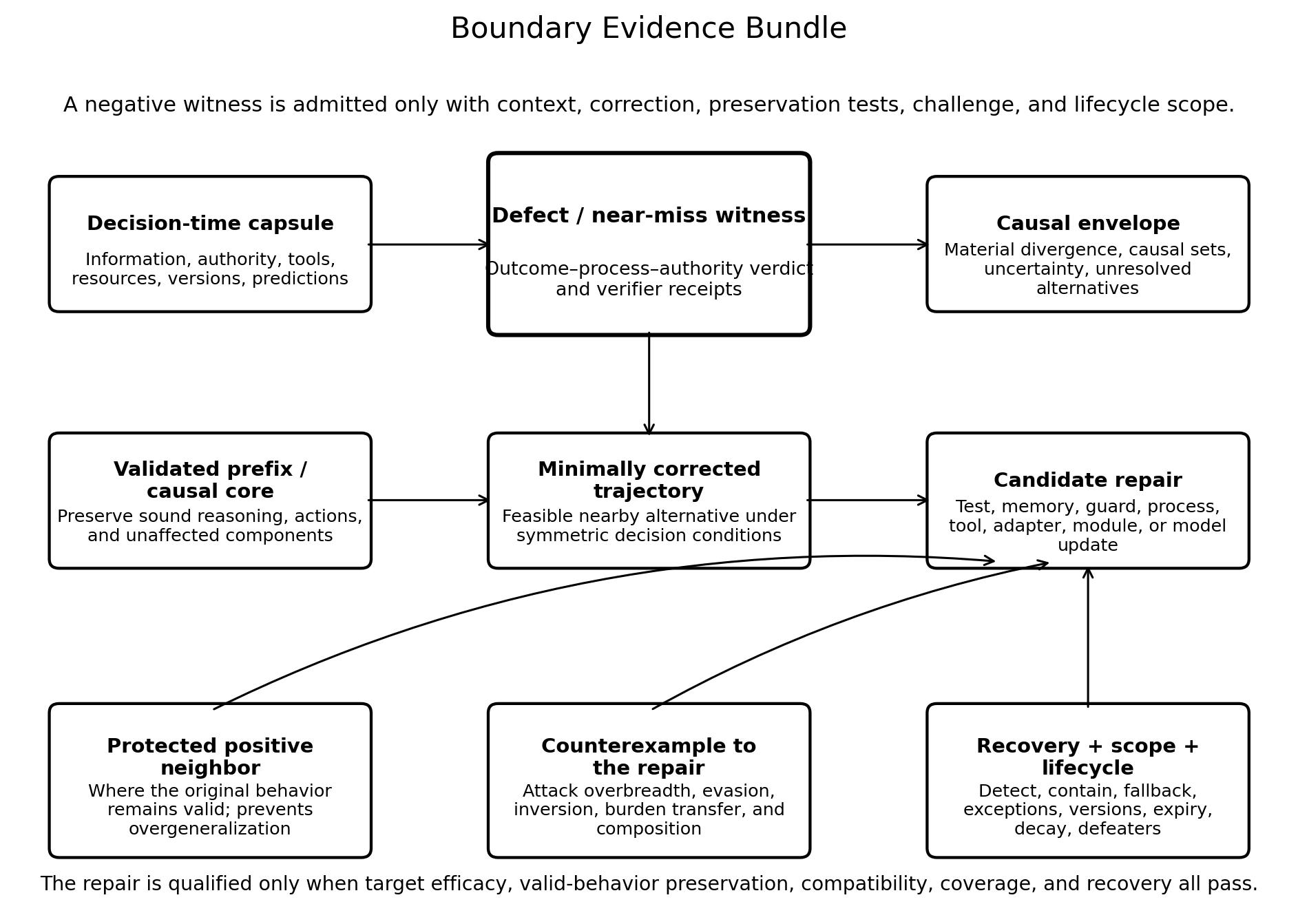
Training or compilation from:
[ + + + ]
should produce lower false inhibition and better transfer than training from a bare failure label or failure–correction pair, under equal total annotation and evaluation cost.
This is a central experimental claim, not an established result.
5.9 Conjecture 3: Outcome–process duality
Monitoring defective-process successes and near misses should predict future failures that outcome-only learning misses. The benefit should be greatest in domains where outcomes are sparse, delayed, stochastic, or weakly verified.
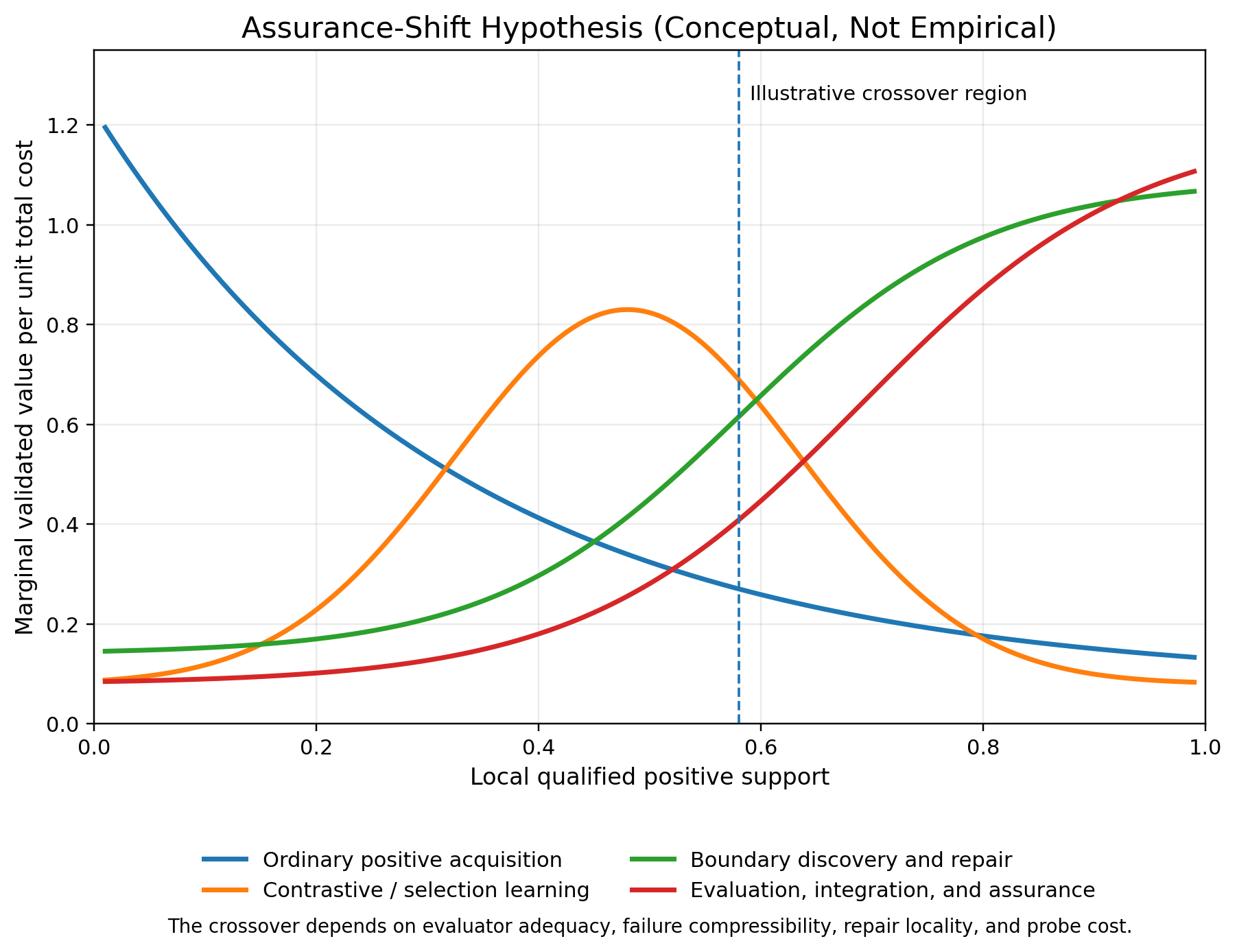
5.10 Conjecture 4: Assurance-dominance transition
Let total mature-improvement cost be:
[ C_{}= C_{}+ C_{}+ C_{}+ C_{}+ C_{}+ C_{}+ C_{}. ]
The conjecture is that in suitable domains:
[ , ]
while the assurance-related share rises. This does not imply that total cost falls. Rare-event discovery and high-quality evaluation may become more expensive than capability generation.
6. Governed Residual Boundary Learning Architecture
GRBL is a learning and assurance system surrounding an actor. It can be implemented with one model, multiple models, deterministic services, human review, or heterogeneous components, but its semantic roles must remain explicit. The full architecture contains six planes.
6.1 Operation plane
The operation plane executes ordinary work under a qualified profile. It contains:
- the active actor or policy;
- contextual routing;
- tool and memory access;
- authority and effect brokers;
- runtime monitors;
- fallback and interruption mechanisms.
The operation plane must emit enough information to reconstruct consequential decision episodes without allowing the actor to edit historical records. It should not be burdened with the full forensic archive on every invocation; runtime retrieval is scoped to relevant, qualified boundary knowledge.
6.2 Evidence plane
The evidence plane records:
- decision-time capsules;
- input and state provenance;
- model, prompt, memory, tool, evaluator, and policy versions;
- predictions and uncertainty;
- observed outcomes and delayed effects;
- process traces where policy permits;
- authority decisions;
- user and stakeholder feedback;
- recovery actions;
- missingness and telemetry failures.
Evidence history is append-only in the sense that past claims and observations are not silently rewritten. This does not require permanent retention of every private payload. Redaction, encryption, commitment-only storage, and authorized deletion can preserve a visible record of evidential loss.
6.3 Discovery plane
The discovery plane searches for informative exceptions through:
- semantic perturbations;
- causal interventions;
- metamorphic testing;
- adversarial scenario generation;
- rare-event simulation;
- formal counterexample search;
- evaluator-disagreement sampling;
- near-miss mining;
- distribution-shift generation;
- repair-specific attacks.
A useful probe is neither merely difficult nor merely unusual. It should be credible, diagnostic, and safe enough to run in the selected environment. Probe generation is itself an adaptive system and can become narrow, gameable, or unrealistic. GRBL therefore retains generator lineage and allocates a nonzero budget to random, externally sourced, and human-generated cases.
6.4 Adjudication plane
The adjudication plane determines whether a candidate incident deserves learning pressure and which subsystem should change. It produces:
- incident validity;
- outcome quality;
- process defensibility;
- authorization status;
- comparator admissibility;
- causal contribution or identified bounds;
- evaluator reliability;
- specification status;
- learning eligibility;
- containment requirements;
- unresolved residuals.
Possible root-cause routes include:
| Missing knowledge |
Retrieval or positive data |
| Missing capability |
Decomposition, tool, specialist, or architecture |
| Selection defect |
Contrastive or negative policy update |
| Calibration defect |
Forecast and uncertainty correction |
| Process defect |
Test, checklist, mandatory verification |
| Execution defect |
Tool contract, state validation, retry discipline |
| Authority defect |
Permission boundary or effect broker |
| Evaluator defect |
Improve or replace the evaluator |
| Specification defect |
Governance and stakeholder review |
| Environment drift |
Requalification and adaptation |
| Stochastic bad luck |
Redundancy, insurance, or recovery rather than blame |
| Multi-agent interaction |
System-level coordination repair |
| Unknown |
Quarantine, contain, and gather evidence |
The actor may submit hypotheses and self-critiques. It may not be the sole authority that admits a material comparator, selects objective weights, assigns root cause, writes a qualified memory, or promotes its own update.
6.5 Repair plane
The repair plane synthesizes candidates in multiple substrates. The search order is not rigid, but the preference is the least invasive adequate causal repair.
Possible destinations are:
- no actor update;
- additional evidence;
- positive capability acquisition;
- external memory;
- retrieval trigger;
- evaluator or regression test;
- deterministic invariant;
- runtime guard or shield;
- process procedure;
- tool or interface redesign;
- recovery policy;
- bounded adapter;
- specialist module;
- base-policy or base-model update;
- architecture redesign;
- specification or governance change.
A rare, exact, volatile exception may belong in memory or a tool. A stable machine-verifiable prohibition may belong in a guard. A broad transferable reasoning defect may justify a model update. A repeated family of local patches may indicate that the underlying representation or interface is wrong.
6.6 Assurance plane
The assurance plane decides where and how a repair may operate. It manages:
- qualification claims and limitations;
- hidden and held-out tests;
- protected positive suites;
- repair counterexamples;
- compatibility and order testing;
- shadow deployment;
- canaries;
- authority scope;
- monitoring windows;
- rollback or fallback;
- compensation plans;
- dependency invalidation;
- expiry and revalidation;
- retirement and supersession.
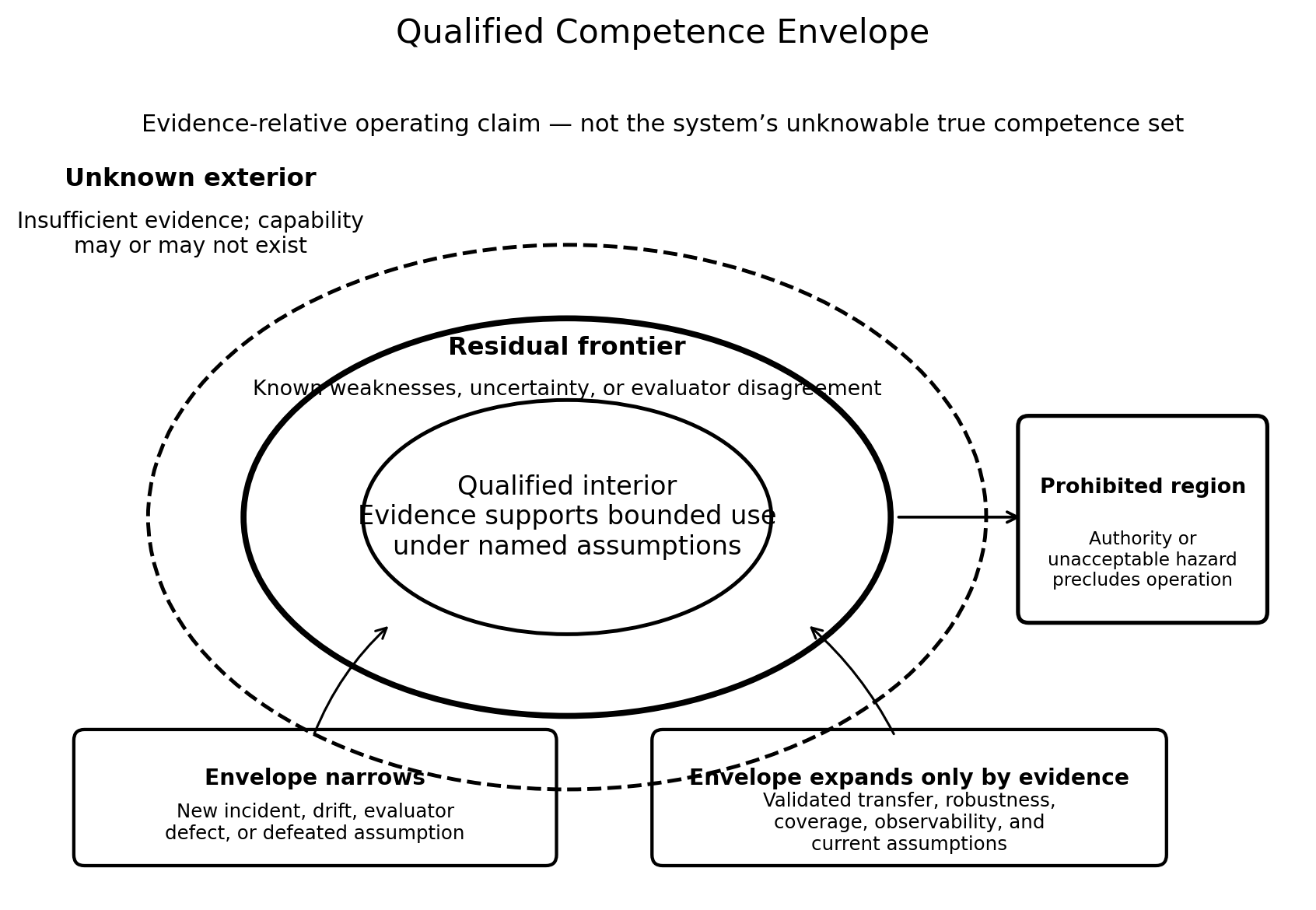
A repair is not “safe” in the abstract. It is qualified for an exact artifact, profile, operating region, dependency closure, evidence state, and period.
6.7 Two adaptation clocks
GRBL separates a fast containment clock from a slow consolidation clock.
Fast clock
The fast clock can activate reversible and scope-limited responses:
- quarantine;
- warning retrieval;
- temporary guard;
- additional confirmation;
- reduced authority;
- fallback routing;
- shadow mode;
- intensified logging;
- temporary adapter with an update lease.
Slow clock
The slow clock controls:
- durable weight updates;
- generalized prohibitions;
- evaluator replacement;
- memory qualification;
- architecture changes;
- specification changes;
- permanent retirement.
This design allows immediate protection without converting one vivid event into permanent superstition.
6.8 Memory strata
Failure-related information is divided by authority and purpose.
| Forensic evidence store |
Raw incidents, traces, exploit details, provenance |
Restricted; not directly actionable |
| Quarantined hypothesis store |
Tentative causes, clusters, counterfactuals, repair ideas |
Investigative only |
| Qualified boundary registry |
Approved bundles, scopes, tests, repairs, expiry |
Runtime influence under policy |
| Protected competence archive |
Positive anchors, valid exceptions, rare capabilities, surplus cases |
Regression and exploration protection |
| Runtime index |
Minimal relevant warnings, checks, and recovery routes |
Invocation-specific |
Content authority is not inherited through summarization. An untrusted webpage does not become trusted merely because the actor paraphrases it into memory. Origin, transform, reviewer, and admission status must survive derivation.
6.9 Evaluator ecology
A mature evaluator portfolio can include:
- formal verifiers;
- deterministic unit and integration tests;
- environmental outcomes;
- learned critics;
- adversarial critics;
- independent model families;
- human reviewers;
- institutional authorities;
- delayed downstream feedback;
- hidden deployment-like probes.
Independence is represented as a vector over model lineage, training data, provider, prompt, tools, organizational incentives, and benchmark exposure. Multiple prompts to one model do not count as multiple independent judges.
Where evaluator uncertainty dominates, GRBL invokes an evaluator-first rule: improve evidence and discrimination before increasing actor optimization against a weak target.
6.10 Repair compatibility hypergraph
Let active repairs be (r_1,,r_n). GRBL represents compatibility through a typed hyperrelation:
[ (S,o,,z) { , , , , , }, ]
where (S) is a subset of repairs, (o) an integration operator, () an update order, and (z) an operating region.
The relation is higher-order because all pairs can appear compatible while a triple conflicts. The system periodically re-synthesizes clusters of patches into coherent implementations, compares the consolidated candidate against the modular composition, and retains rollback lineage.
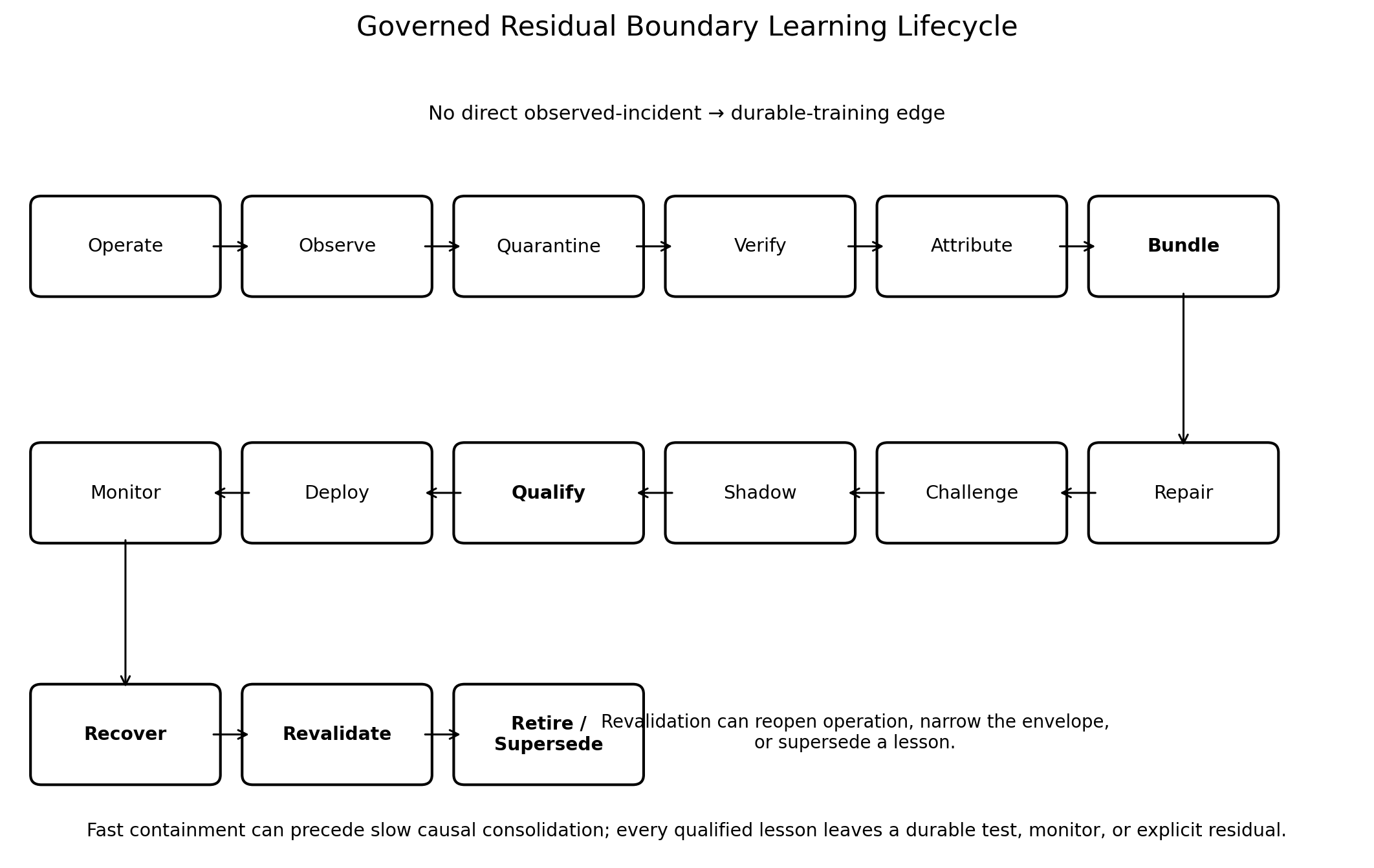
6.11 End-to-end lifecycle
The full lifecycle is:
[ , ]
[ , ]
[ . ]
There is intentionally no direct () edge.
References
Achiam, Joshua, David Held, Aviv Tamar, and Pieter Abbeel. 2017. “Constrained Policy Optimization.” Proceedings of the 34th International Conference on Machine Learning, PMLR 70:22–31.
Akhtar, Mubashara, Anka Reuel, Prajna Soni, et al. 2026. “When AI Benchmarks Plateau: A Systematic Study of Benchmark Saturation.” arXiv:2602.16763.
Amodei, Dario, Chris Olah, Jacob Steinhardt, Paul Christiano, John Schulman, and Dan Mané. 2016. “Concrete Problems in AI Safety.” arXiv:1606.06565.
Bai, Yuntao, Saurav Kadavath, Sandipan Kundu, et al. 2022. “Constitutional AI: Harmlessness from AI Feedback.” arXiv:2212.08073.
Bellemare, Marc G., Will Dabney, and Rémi Munos. 2017. “A Distributional Perspective on Reinforcement Learning.” Proceedings of the 34th International Conference on Machine Learning, PMLR 70:449–458.
Cheng, Quan. 2026. “Via Negativa for AI Alignment: Why Negative Constraints Are Structurally Superior to Positive Preferences.” arXiv:2603.16417.
Chhetri, Vinaik, A. B. Siddique, and Umar Farooq. 2025. “Understanding Robustness of Model Editing in Code LLMs: An Empirical Study.” arXiv:2511.03182.
Dash, Pritam, Tongyu Ge, Aditi Jain, Tanmay Shah, and Zhiwei Shang. 2026. “From Untrusted Input to Trusted Memory: A Systematic Study of Memory Poisoning Attacks in LLM Agents.” arXiv:2606.04329.
Dennis, Michael, Natasha Jaques, Eugene Vinitsky, Alexandre Bayen, Stuart Russell, Andrew Critch, and Sergey Levine. 2020. “Emergent Complexity and Zero-shot Transfer via Unsupervised Environment Design.” Advances in Neural Information Processing Systems 33.
Everitt, Tom, Marcus Hutter, Ramana Kumar, and Victoria Krakovna. 2021. “Reward Tampering Problems and Solutions in Reinforcement Learning: A Causal Influence Diagram Perspective.” Synthese 198 (Suppl. 27): 6435–6467. arXiv:1908.04734.
Gartmeier, Martin, Johannes Bauer, Hans Gruber, and Helmut Heid. 2008. “Negative Knowledge: Understanding Professional Learning and Expertise.” Vocations and Learning 1:87–103. https://doi.org/10.1007/s12186-008-9006-1.
Geifman, Yonatan, and Ran El-Yaniv. 2019. “SelectiveNet: A Deep Neural Network with an Integrated Reject Option.” Proceedings of the 36th International Conference on Machine Learning, PMLR 97:2151–2159.
Gupta, Akshat, Anurag Rao, and Gopala Anumanchipalli. 2024. “Model Editing at Scale Leads to Gradual and Catastrophic Forgetting.” Findings of the Association for Computational Linguistics: ACL 2024, 15202–15232. https://doi.org/10.18653/v1/2024.findings-acl.902.
Han, Tianyang, Hengyu Shi, Junjie Hu, Xu Yang, Zhiling Wang, and Junhao Su. 2026. “Correct Is Not Enough: Training Reasoning Planners with Executor-Grounded Rewards.” arXiv:2605.03862.
Hubinger, Evan, Carson Denison, Jesse Mu, et al. 2024. “Sleeper Agents: Training Deceptive LLMs that Persist Through Safety Training.” arXiv:2401.05566.
Huo, Yusen, Changping Wang, Yangru Huang, Jun Zhang, and Jie Jiang. 2026. “Breaking the Curse of Repulsion: Remoteness-Aware Control of Negative Off-Policy Updates.” arXiv:2602.10430, revised July 2026.
Jha, Susmit, and Sanjit A. Seshia. 2017. “A Theory of Formal Synthesis via Inductive Learning.” Acta Informatica 54 (7):693–726. https://doi.org/10.1007/s00236-017-0294-5.
Jiang, Minqi, Edward Grefenstette, and Tim Rocktäschel. 2021. “Prioritized Level Replay.” Proceedings of the 38th International Conference on Machine Learning, PMLR 139:4940–4950.
Jiang, Nan, and Lihong Li. 2016. “Doubly Robust Off-policy Value Evaluation for Reinforcement Learning.” Proceedings of the 33rd International Conference on Machine Learning, PMLR 48:652–661.
Kirkpatrick, James, Razvan Pascanu, Neil Rabinowitz, et al. 2017. “Overcoming Catastrophic Forgetting in Neural Networks.” Proceedings of the National Academy of Sciences 114 (13):3521–3526.
Lightman, Hunter, Vineet Kosaraju, Yura Burda, et al. 2024. “Let’s Verify Step by Step.” International Conference on Learning Representations. arXiv:2305.20050.
Lin, Zihan, Xiaohan Wang, Jie Cao, et al. 2026. “ResRL: Boosting LLM Reasoning via Negative Sample Projection Residual Reinforcement Learning.” arXiv:2605.00380.
Liu, Xun, Yi Evie Zhang, Vira Kasprova, et al. 2026a. “AgentAbstain: Do LLM Agents Know When Not to Act?” arXiv:2607.10059.
Liu, Haolin, Dian Yu, Sidi Lu, et al. 2026b. “Save the Good Prefix: Precise Error Penalization via Process-Supervised RL to Enhance LLM Reasoning.” arXiv:2601.18984.
Madaan, Aman, Niket Tandon, Prakhar Gupta, et al. 2023. “Self-Refine: Iterative Refinement with Self-Feedback.” arXiv:2303.17651.
Mindermann, Sören, Jan M. Brauner, Muhammed T. Razzak, et al. 2022. “Prioritized Training on Points that Are Learnable, Worth Learning, and Not Yet Learnt.” Proceedings of the 39th International Conference on Machine Learning, PMLR 162:15630–15649.
Mirto, Fabio Orazio, Luca D’Agati, Giuseppe Tricomi, et al. 2026. “Beyond Component Testing: Validating Agentic AI Systems.” arXiv:2607.29405.
Oberst, Michael, and David Sontag. 2019. “Counterfactual Off-Policy Evaluation with Gumbel-Max Structural Causal Models.” Proceedings of the 36th International Conference on Machine Learning, PMLR 97:4881–4890.
Parker-Holder, Jack, Minqi Jiang, Michael Dennis, et al. 2022. “Evolving Curricula with Regret-Based Environment Design.” Proceedings of the 39th International Conference on Machine Learning, PMLR 162:17473–17498.
Schaul, Tom, John Quan, Ioannis Antonoglou, and David Silver. 2016. “Prioritized Experience Replay.” International Conference on Learning Representations. arXiv:1511.05952.
Shinn, Noah, Federico Cassano, Edward Berman, Ashwin Gopinath, Karthik Narasimhan, and Shunyu Yao. 2023. “Reflexion: Language Agents with Verbal Reinforcement Learning.” Advances in Neural Information Processing Systems 36:8634–8652.
Sorenson, Corben. 2026a. The Regret Engine: Governed Counterfactual Regret for Continual Learning, Prospective Control, and Durable AI Improvement. Independent research manuscript.
Sorenson, Corben. 2026b. Importance-Weighted Context Compaction for Long-Horizon LLM Agents. Independent research manuscript.
Sorenson, Corben. 2026c. Learning–Compute Topology: Formalizing the Causal Organization of Adaptive Systems. Independent research manuscript.
Sorenson, Corben. 2026d. Stable Capability Fields: A Governed Substrate for Recursive AI Self-Improvement. Independent research manuscript.
Stephan, Moritz, Alexander Khazatsky, Eric Mitchell, et al. 2024. “RLVF: Learning from Verbal Feedback without Overgeneralization.” arXiv:2402.10893.
Welleck, Sean, Ilia Kulikov, Stephen Roller, Emily Dinan, Kyunghyun Cho, and Jason Weston. 2020. “Neural Text Generation with Unlikelihood Training.” International Conference on Learning Representations. arXiv:1908.04319.
Wu, Haoze, Cheng Wang, Wenshuo Zhao, and Junxian He. 2025. “Model–Task Alignment Drives Distinct RL Outcomes.” arXiv:2508.21188.
Xia, Jun, Lirong Wu, Ge Wang, Jintao Chen, and Stan Z. Li. 2022. “ProGCL: Rethinking Hard Negative Mining in Graph Contrastive Learning.” Proceedings of the 39th International Conference on Machine Learning, PMLR 162:24332–24346.
Xiao, Frank, and Mary Phuong. 2026. “Generalization Hacking: Models Can Game Reinforcement Learning by Preventing Behavioral Generalization.” arXiv:2606.12016.
Zhong, Ziqian, Ivgeni Segal, Ivan Bercovich, Shashwat Saxena, Kexun Zhang, and Aditi Raghunathan. 2026. “Hardening Agent Benchmarks with Adversarial Hacker-Fixer Loops.” arXiv:2606.08960.
Zhu, Xinyu, Mengzhou Xia, Zhepei Wei, Wei-Lin Chen, Danqi Chen, and Yu Meng. 2025. “The Surprising Effectiveness of Negative Reinforcement in LLM Reasoning.” arXiv:2506.01347.